
The EPA Is Studying Microplastics While Plastic Production Continues to Expand
As the EPA studies microplastics, communities like Flint are still living with the consequences of government failure.


The federal government is launching a $144-million effort to study microplastics in the human body and drinking water, while the Environmental Protection Agency moves to formally classify them as priority contaminants. On its face, this signals long-overdue recognition of a growing crisis—one that scientists and advocates have been documenting for years as microscopic plastic fragments accumulate in everything from blood and breast milk to tap water.
But taken together, these moves reveal something more familiar about how environmental risk is managed in the United States. The focus tends to sharpen once harm becomes measurable and diffuse, even as the systems producing that harm continue largely unchanged.
Microplastics are, in many ways, the ideal subject of federal attention. They are everywhere, difficult to trace to a single source, and framed as an emerging concern that requires more research. The questions now being asked—what is in the body, what health impacts it causes, and how it might be removed—are important. But they sit at the far end of a much longer chain of decisions, where the emphasis is on measuring harm rather than preventing it.
That chain begins with plastic production itself, rooted in a petrochemical sector that continues to expand at scale. A 2024 analyses by the Center for International Environmental Law indicate that planned US petrochemical projects could drive emissions comparable to adding dozens of coal plants each year, locking in fossil fuel use for decades to come. And more recently, a coalition of state attorneys general has warned companies against participating in voluntary efforts to reduce plastic use, arguing that initiatives like the U.S. Plastics Pact could raise antitrust concerns. The irony is hard to ignore. The pact itself is industry-led, bringing together major corporations to set modest targets for reducing plastic waste. Yet even that level of coordination is now being treated as a potential liability.
The result is a regulatory posture that appears increasingly comfortable studying the consequences of plastic while placing far fewer constraints on its production.
This pattern is not unique to plastics. It reflects a broader tendency to respond more decisively to problems once they are widespread and measurable than when they are concentrated and preventable.
It’s hard not to think about Flint, Michigan, where more than a decade ago a cost-driven decision set off a catastrophic water crisis that impacted the majority-Black city. The result exposed over 100,000 residents to lead-contaminated water for years despite early warnings from engineers and immediate complaints from community members. The harm was identifiable and unfolding in real time—in discolored tap water, in its smell and taste, in wide spread health complaints from residents, and in the warnings from engineers that were ignored. Yet any semblance of government intervention came slowly, followed by years of remediation and an ongoing debate about whether the crisis has truly been resolved.
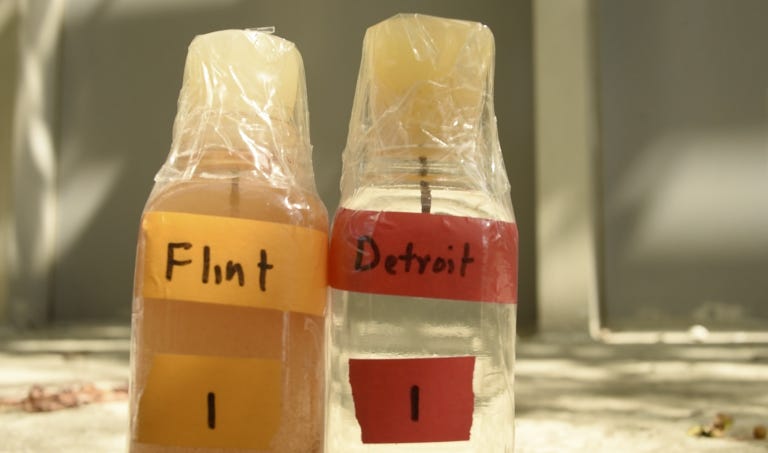
Flint is not analogous to microplastics in any technical sense, but it is instructive in another way. It shows how long it can take for known harms to trigger sustained action, even when the source is clear and the consequences are severe.
Against that backdrop, the current focus on microplastics raises a more complicated question than whether they deserve regulatory attention. Of course they do. The issue is how that attention is distributed—what is studied without any clear timeline for when it will translate into regulation or protection, what prompts timely action, and what is allowed to persist even when the risks are already clear.
Part of the answer lies in the nature of the problem itself. Microplastics are diffuse, global, and difficult to attribute. They lend themselves to research programs, monitoring frameworks, and long-term study. Plastic production and the petrochemical industry, by contrast, is concentrated, politically sensitive, and tied to powerful economic interests. Limiting it would require confronting those interests directly.
That distinction shapes the policy response. It is easier to fund studies than to restrict production, even with its insurmountable health impacts. Simply put, it’s more politically palatable to track contamination than to prevent it.
None of this diminishes the importance of understanding microplastics. But without a corresponding effort to address the systems that generate them—and without a stronger commitment to resolving longstanding water crises—the current approach risks reinforcing a familiar imbalance.